|
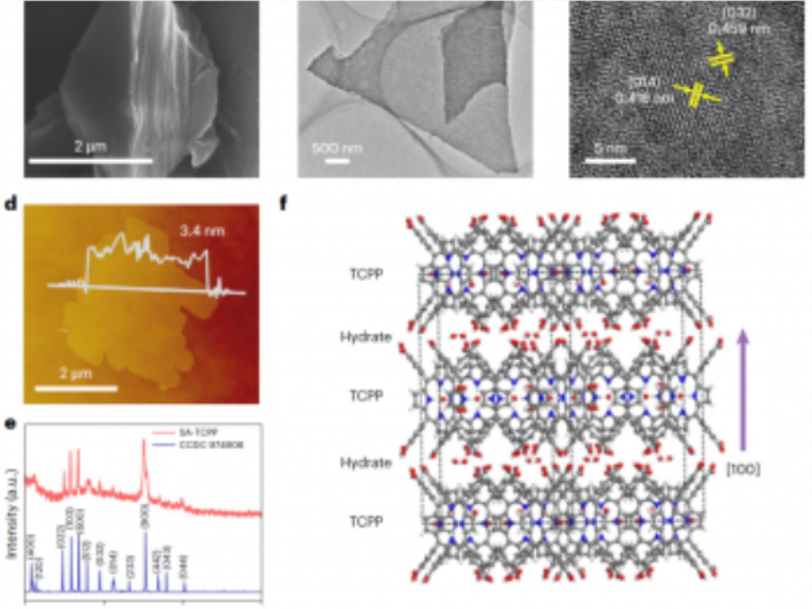
Hydrogen peroxide (H2O2) is an important industrial chemical and a potential energy carrier. Photocatalytic synthesis of H2O2 is an attractive alternative to the traditional anthraquinone process for producing H2O2, but the catalyst systems that have been explored so far have many problems, including limited sunlight wavelength response, the need to sacrifice reagents, and insufficient activity. Professor Yongfa Zhu’s team and others reported a self-assembled four (4-carboxyphenyl) porphyrin supramolecular photocatalyst that produces H2O2 from only H2O and O2, with quantum efficiencies of 14.9% and 1.1% at 420 nm and 940 nm, respectively. When simulated sunlight irradiation and heating were applied, the catalyst achieved a solar-to-chemical conversion efficiency of 1.2% at 328 K. The results show that photo-generated electrons and holes promote H2O2 production by reacting at different active sites such as the pyrrole N-H ring and carboxyl groups. In particular, this paper proposes a hole-induced H2O2 generation process, which involves the -COOH on the catalyst being converted to -CO3H under light, and then thermally decomposed. The related work, titled “H2O2 generation from O2 and H2O on a near-infrared absorbing porphyrin supramolecular photocatalyst,” was published in Nature Energy."
|